
For years, if you walked east far enough along the Waterfront Renaissance Trail, past the restaurants and the condos and the Wendy Rose statue, you hit a chain-link fence. Beyond it: an unpaved triangle of weeds, some vandalized concrete barriers, and a spray-painted message that read "Live life." Regulars called it the weird spot. Officially, the trail didn't dead-end there. The next paved segment picked up more than a mile east, near the Water Resources Education Center, connected only by a sidewalk that ran along a commercial road. Practically, it was where your riverside walk turned into a U-turn.
That spot has a name now, and a story worth knowing if you've ever grumbled your way through that turnaround. Renaissance Pointe officially opened to the public this spring, and how it got built says something about how this stretch of the river actually gets fixed.
The question nobody at city hall answered
The fenced-off triangle sat there for years, unbudgeted and unbuilt, until a Clark County Sheriff's detective named Jeremy Brown started asking the obvious question on his daily walks: why does the trail just end like this? Brown was killed in the line of duty in July 2021. His widow, Jill Brown, kept walking that stretch of river on her own afterward, and on one of those walks she noticed the graffiti at the dead end again. She decided the question deserved an answer.
What followed wasn't a city capital project working its way through a budget cycle. It was a fundraising campaign that didn't even last a year, built through a consulting partnership called Alchemy Partners, run by retired Vancouver City Manager Eric Holmes and his wife Elizabeth. A $100,000 grant from the Ed & Dollie Lynch Fund at the Community Foundation for Southwest Washington got it most of the way. Another $46,000 came from the Parks Foundation of Clark County. The rest came from the kind of gifts and sponsorships that show up when a community decides a project is theirs.
Funding a park without a bond measure
The math is worth sitting with for a second. An updated construction estimate in November 2025 raised the target from $170,000 to $218,000, and by January the project was already fully funded, with organizers noting that any donations exceeding the final construction cost would stay with the Parks Foundation's general fund rather than get returned. That's not how most public infrastructure gets built in this city. Most of it waits for a budget line, a council vote, a multi-year phase plan. This got built because enough people decided a dead end named for a fallen officer's unanswered question wasn't going to stay a dead end.
"It's kind of a weird spot."
That's how Jill Brown described the site to a Columbian reporter before construction started. It's not a weird spot anymore.
What's actually there now
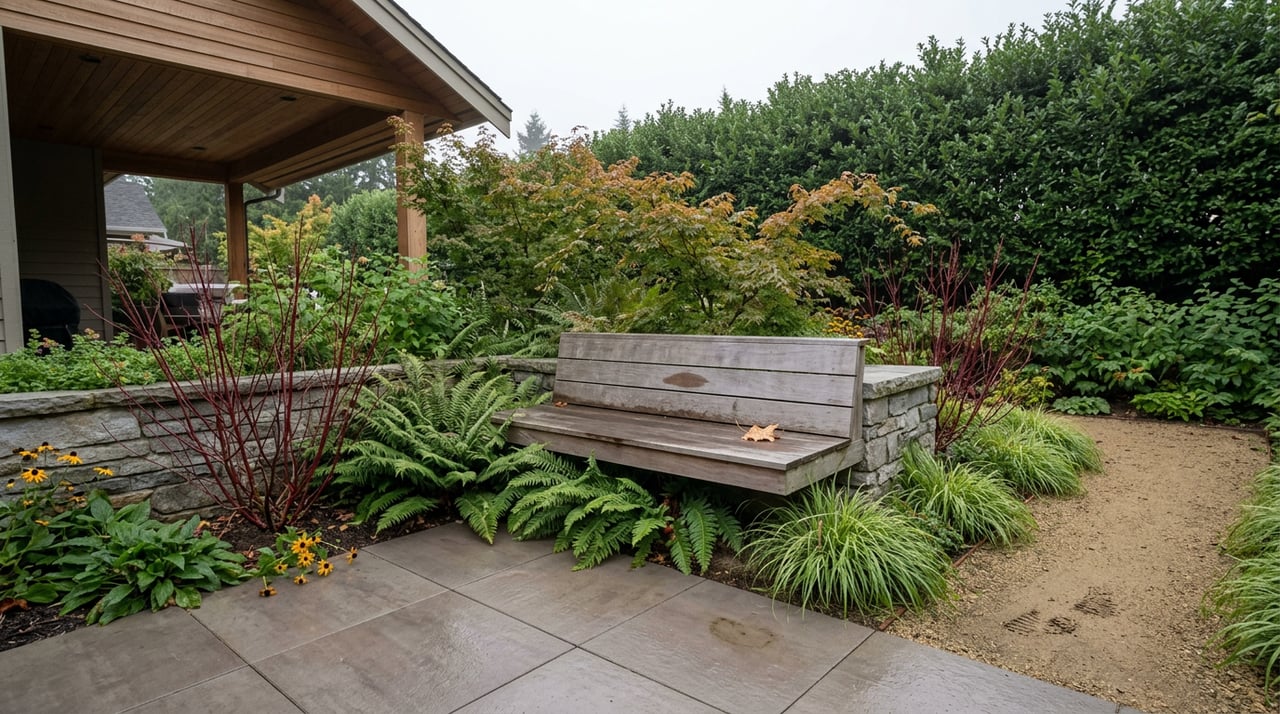
Renaissance Pointe opened this spring after what The Columbian described as a yearlong restoration effort. The pocket park has a fresh gravel path that winds through native plantings, four benches facing the Columbia, and Jeremy Brown's memorial plaque mounted on a concrete piling near the river. It's a small space by park standards, roughly an acre and a half, but it does something the old triangle never could: it gives you a reason to stop at the end of that walk instead of just turning around.
If you've been putting off that eastern stretch of the trail because you already know how it ends, this is the update that changes that.
The rest of the walk, if you're doing the whole thing
The Waterfront Renaissance Trail runs roughly five miles along the river, and most people only ever walk a piece of it. Here's the route in order, heading east from downtown:
- Esther Short Park, established in 1853 and the oldest public park in Washington, where the Salmon Run Bell Tower's glockenspiel depicts a Chinook tale with a leaping salmon.
- Vancouver Waterfront Park, a 35-acre stretch built on a former mill site, anchored by the cable-stayed Grant Street Pier, a 90-foot structure designed by public artist Larry Kirkland that juts out over the river.
- The Grant Street restaurant row, where WildFin American Grill and Twigs Bistro and Martini Bar anchor the two flagship buildings, with DosAlas Latin Kitchen and Tequila Bar upstairs and Waterfront Taphouse offering a patio view of the pier.
- The Wendy Rose statue, commonly called Wendy the Welder, commemorating the women who worked at the Kaiser Shipyards during World War II.
- Renaissance Pointe, the newly opened plaza at what used to be the trail's awkward turnaround.
- Water Resources Education Center, at 4600 SE Columbia Way, where the trail picks back up along the river after the interior sidewalk detour.
- Marine Park, with the Kaiser Viewing Tower, a boat launch, and picnic tables along the water.
- Wintler Community Park, at 6400 Beach Drive, the trail's eastern end, with a beach and seasonal restrooms.
Walk it start to finish and you cover the full arc of this city's relationship with its own river: a Chinook legend in a bell tower, a WWII shipyard memorial, a fallen officer's name on a piling, and a working wastewater education center that still teaches kids where their tap water comes from.
Two other things changing on this same stretch
The Water Resources Education Center is worth a second look right now too. It reopened to the public two Saturdays a month starting April 4, 2026, after years of shrinking crowds and a plan to replace nearly all of its exhibits. Center supervisor Kristin Smith called it a slow rollout based on staff capacity. It's open the first and third Saturday of each month from noon to 4 p.m., and Smith pointed out the obvious pairing: pack a picnic lunch for the back patio, then kick off a walk down the Renaissance Trail straight from the parking lot.
Back at the other end of the trail, the Vancouver Farmers Market at Esther Short Park is already thinking about the season after this one. Applications for the 2026–27 downtown fall and winter market are open through August 31. The flagship market has run at that spot since 1990 and now hosts somewhere between 150 and 270-plus vendors depending on the season, enough that Eater Portland's overview of the city singled out specific stalls by name: Taiwanese dan bing and fan tuan from Small Eats, ahi poke from Husubis' Poke Shop, and Detroit-style pizza from Pi Square, run by Houston transplant Sally Huynh.
What this actually tells you about the neighborhood
None of these three things happened because a developer needed them to sell units or a city department had budget to spare. A widow raised money for a memorial plaza because her husband asked a question nobody had answered. A water education center is clawing back its Saturday hours through staff scheduling, not a new appropriation. A farmers market that's been running since 1990 is doing its own vendor outreach for a season three months out.
That's the pattern worth noticing if you spend real time on this stretch of river: the parts of it that feel most cared for are usually the parts a resident cared enough about to push on directly. It's a small data point, but it's the kind that tells you more about a place than any single ribbon-cutting does.
If you already walk this trail, you'll notice the difference at the east end the next time you're out there. And if you're the kind of person who pays attention to a neighborhood changing in small, specific ways like this, that instinct tends to be useful for more than trail walks. Property Sisters & Co. works this stretch of Clark County closely enough to notice these things too. If you're ever curious what your own corner of it is worth, request a free home valuation and we'll walk you through it, no chain-link fence required.
